After working for over 6 months on a new site it is finally all coming together and nickedit.co.uk is about to launch in the next 2 weeks.
nickedit.co.uk is a voucher discount site and has been built using .NET 3.5 and Entity framework. Initially, the idea was to write the whole application in .NET 4.0 using MVC and Entity Framework, but due to large scale restrictions imposed by the hosting provider (fasthosts.com) I ended up coding it in classic ASP.NET forms.
nickedit.co.uk not only has a user friendly front end design but also a fully functional backend admin interface allowing the client to add new products, audit sales and create new offers.
The site has also been build with a complete set of code documentation and multi tier separation for easy support, by anyone who knows how to write in C#.NET
Showing posts with label development. Show all posts
Showing posts with label development. Show all posts
Wednesday, October 12, 2011

Thursday, August 18, 2011
Sometimes even the simplest stuff catches you out
I was playing around with using web services in a classic ASP.NET form web application, so that I could easily use jquery ajax calls to modify data. All was working fine until I deployed onto my hosting provider's web space, where I got the following error:
<webServices>
<protocols>
<add name="HttpGet"/>
<add name="HttpPost"/>
</protocols>
</webServices>
System.InvalidOperationException: Request format is unrecognized for URL unexpectedly ending in '/MethodName'It turns out it's another web.config setting (which makes sense) where you have to specify the required protocols. Here is the code:
<webServices>
<protocols>
<add name="HttpGet"/>
<add name="HttpPost"/>
</protocols>
</webServices>
Thursday, July 28, 2011
Linq to Entity outer joins
Just spend a large amount of time trying to do a simple Linq to entity statement which in SQL would have taken me 5 minutes. What I tried to do, is left outer joins on entities that could not be placed on the left hand side of the equals and I got the following error:
Hope it helps.
the name '' is not in scope on the left hand side of equalsWhat you need to do is the following:
join users in entities.Users on new { ID = userroles.fkUserId } equals new { ID = users.ID } into users_join from users in users_join.DefaultIfEmpty()To place the entity on the left you need to declare "on new { ID = userroles.fkUserId } equals new { ID = users.ID }", so basically swapping the values around!
Hope it helps.
Tuesday, September 14, 2010
New account activation for new students
We have just completed the development of the newly improved activation process for our new students. This application allows students to activate their computing account and set their chosen password. Since its launch last Thursday, it has attracted over 900 users and resulted in a much improved account activation service for our new students.

Following the activation of their computing account, students are able to access all online IT services that the university provides as well as log onto any of the university's desktops.
We feel that this improvement has helped new students in completing their pre-registration tasks which will greatly improve their first experience with Canterbury Christ Church University.
Monday, August 16, 2010
StudentNET extends to our accepted students
We have extended the student portal to include students that have been accepted on a course of study and are required to pre-register online before arriving at the registration event in September time.
The new 'stage' of the portal has several new widgets including 'Key things to know', 'Top questions' and 'Essential first steps' as well as drawing on the functionality of previously developed widgets including the 'WebNote' and 'i-zone search and browse'.
This portal will allow students to confirm their place of study with us, get their arrival instructions, upload their photo, and apply for and accept University accommodation places, as well as being introduced to the student portal with which they will interact for the next 3 years or more.

Thursday, June 24, 2010
Fitting development methodologies
It seems to me that with cutting resources the need for structured methodologies is more and more important. The use of the waterfall methodology seems the obvious choice, because it is designed to cut down on feature creap and allows for easy management, but others have a place too.
Monday, March 15, 2010
StudentNET Content
This paper describes how student content could be treated once removed from the external web. Its purpose is to start a discussion.
Option 1 - Full content integration into StudentNET V2
Similar to content administered by the i-zone content would be surfaced using the 'app area' in StudentNET V2.

The advantage of this approach is that it is in keeping with existing design and functionality.
Option 2 - Layered content integration into StudentNET V2
Following the original StudentNET vision, content would be surfaced using a conventional, layered web structure.This layered content would be accessed through an 'A-Z app widget' from StudentNET V2. It could also be accessible through direct URLs.
E.G.: https://secure.canterbury.ac.uk/student/subject1/
E.G.: https://secure.canterbury.ac.uk/student/subject1/
The advantage with this approach is that it appears to be more scalable. It allows for more flexibility when having to cater for all CCCU's departments' needs.
Content structure
With either option the content structure needs to be carefully designed to allow for content to be reused in different areas of the web and in different media.
Content would be packaged up in logical subject sections. These subject sections may be informed by the more detailed content audit.
Content administration
With either option Contensis CMS would be used to administer content and support workflow rules.
Content rules will be important because content will be edited from staff across departments.
Tuesday, February 09, 2010
Change password online - Manage My Account
CCCU staff and students are now able to change their passwords online using a new application built by CIS with assistance from CS.
So, if you have ever forgotten your password or locked your account, no need to worry. Soon you will be able to reset and change your University password and unlock your computing account online.
This is the first step in delivering a complete computing account self service online to all current staff and accepted and enrolled students. This will include the ability to unlock the account if it was locked and reset your password if it has been forgotten as well as keeping your secret questions and answers up to date.
So, if you have ever forgotten your password or locked your account, no need to worry. Soon you will be able to reset and change your University password and unlock your computing account online.
Thursday, September 17, 2009
StudentNET stress testing - it's not just about running the scripts ...
We have done some preliminary stress tests to see how StudentNET responds to high levels of usage. To start us off we created very simple test scripts that simulated a user logging on, loading the framework and logging off.
Creating test scripts using Visual Studio Team Foundation is a piece of cake, so at first we didn't stumble upon any problems. Within a few minutes of launching the wizard, the script was created in C# and we were ready to set up the first load test.
For an adequate load test we needed to have at least 4 agents that would be sending requests to our web servers; a controller that would be distributing the test load among the agents; a test client that executes the script. Now, considering we do not have a testing environment, let alone a testing lab, we had to make do with PCs of colleagues that were on holiday. So getting together 6 PCs was difficult enough.
Setting up the testing grid with staff PCs proved to be quite tricky. At first we had problems connecting the client (runs the scripts) to the controller (distributes the load). A few IPCONFIGS later we discovered that the two machines were on completely different IP ranges and were unable to resolve the machine name. Even though we were able to connect via IP, Visual Studio Team Foundation did not work, seemingly because the controller tried to contact the client with its name, which again did not resolve.
Secondly, running Virtual PC 2007 on our staff PCs meant that all 6 machines were too weak to generate a load that we would have wanted to test. It created a bottle neck of 300 requests to our web servers at any one time before the agents started to fail.
So we reduced the load of concurrent users to be able to run a few 5 hour tests to see whether the application was deteriorating in any way. Although this significantly reduced the load on our webfarm and resulted in minimal load balancing, we were able to fetch a few results that helped us improve the application.
Next steps
Creating test scripts using Visual Studio Team Foundation is a piece of cake, so at first we didn't stumble upon any problems. Within a few minutes of launching the wizard, the script was created in C# and we were ready to set up the first load test.
For an adequate load test we needed to have at least 4 agents that would be sending requests to our web servers; a controller that would be distributing the test load among the agents; a test client that executes the script. Now, considering we do not have a testing environment, let alone a testing lab, we had to make do with PCs of colleagues that were on holiday. So getting together 6 PCs was difficult enough.
Set up
Setting up the testing grid with staff PCs proved to be quite tricky. At first we had problems connecting the client (runs the scripts) to the controller (distributes the load). A few IPCONFIGS later we discovered that the two machines were on completely different IP ranges and were unable to resolve the machine name. Even though we were able to connect via IP, Visual Studio Team Foundation did not work, seemingly because the controller tried to contact the client with its name, which again did not resolve.
Secondly, running Virtual PC 2007 on our staff PCs meant that all 6 machines were too weak to generate a load that we would have wanted to test. It created a bottle neck of 300 requests to our web servers at any one time before the agents started to fail.
So we reduced the load of concurrent users to be able to run a few 5 hour tests to see whether the application was deteriorating in any way. Although this significantly reduced the load on our webfarm and resulted in minimal load balancing, we were able to fetch a few results that helped us improve the application.
Next steps
We're going back to the framework to improve its load and also to fix fundamental errors that cropped up during stress tests.
We are also going to look at the possibility of using a Virtual Environment to run 10-12 agents to increase the stress on our web servers.
Monday, June 29, 2009
First mini barcamp experience
I held a barcamp session today. After 3 years of attending the IWMW, I finally plucked up the courrage to speak in front of my peers at this years IWMW at the University of Essex.
My session was about our development efforts towards delivering a new student portal at Canterbury Christ Church. The session, I think, was well received a few delegates have contacted me since wanting to be kept informed about our progress and student feedback.
You never know, we might be able to share the portal and collaborate on future widget developments.
My session was about our development efforts towards delivering a new student portal at Canterbury Christ Church. The session, I think, was well received a few delegates have contacted me since wanting to be kept informed about our progress and student feedback.
You never know, we might be able to share the portal and collaborate on future widget developments.
Thursday, June 11, 2009
StudentNET Pre-registration Portal is coming
We have just completed the first stage of the new Canterbury Christ Church University pre-registration portal. It currently lets prospective students log in and supply us with a working email address, so that we are able to guide them through pre-registration. This means that when they arrive at Christ Church, their induction and formal registration will run more smoothly than before.
The next steps of this development are crucial. We will expand our newly built FAQ system to this area and re-purpose and re-fresh most of our tired web content that is spread across our currently unmanaged website. It will also see the creation of packaged up content to support most if not all pre-registration steps that they need to take to successfully register at CCCU.
The next steps of this development are crucial. We will expand our newly built FAQ system to this area and re-purpose and re-fresh most of our tired web content that is spread across our currently unmanaged website. It will also see the creation of packaged up content to support most if not all pre-registration steps that they need to take to successfully register at CCCU.
There will be a 'Uplod your photo' application so that students can provide us with their photo to get their uni cards, and just before they arrive at Christ Church, they will be able to activate their computing account from the comfort of their homes.
Tuesday, May 26, 2009
Google analytics is our choice
The webteam have written a discussion paper about the use of Google Analytics versus our current analytics software. Following research, consultation with our users and 'trial and error', we have come to the conclusion that it would be beneficial to the University to use Google Analytics as our primary analytics tool. The main reasons for this were, no cost and better usability.
We deemed the risk of the service from Google being unavailable minor enough to be acceptable and would varify its accuracy by comparing the results to our own server logs on a regular basis.
We were pleased when our 'Web Steering Group', the overarching group that makes decisions about the University's online development, accepted the paper.
Yes, like many, we too are selling our soul to the Google empire.
We deemed the risk of the service from Google being unavailable minor enough to be acceptable and would varify its accuracy by comparing the results to our own server logs on a regular basis.
We were pleased when our 'Web Steering Group', the overarching group that makes decisions about the University's online development, accepted the paper.
Yes, like many, we too are selling our soul to the Google empire.
Friday, March 20, 2009
StudentNET Development Update
The current student home page is being replaced by a totally new portal., StudentNET. The portal will present the student with an extended range of facilities as well as easy to use customisation tools.
The technology underpinning the portal is also new. The current StudentNET is effectively a web page that brings together a variety of student related applications and services. The new version of StudentNET will be a true portal that will give the student seamless, authenticated access to relevant services and applications. One advantage of an authenticated portal is that the system will be aware of who the user is and will be able to tailor the facilities presented to match the user’s profile. For example a final year student will not normally be presented with the option to re-enrol for the following session.
The development of the portal is being shared between CIS within the University and an external software supplier. The external company, Ballard Chalmers, has been contracted to provide the portal framework using a product known as ‘Drop Things’. The final version of the work from Ballard Chalmers is due to be delivered at the end of April and will be delivered complete with the university’s styling already incorporated into the framework. The University will develop the content (known as widgets) and this will include a variety of university applications, RSS feeds and some of the more popular social sites (in the first instance Flickr, an image sharing site). Once the framework is delivered CIS will progressively develop and introduce the widgets so that the functionality is incrementally increased. In the case of the student administration functionality, it will be introduced to coordinate with the student calendar. CIS are currently developing a detailed project plan and deliverables map but the mock-up included in this report is a reasonable approximation of the content and appearance of the intended phase 1 deliverables.
The portal will include the concept of an ‘application area’ where those widgets that require a work area will ‘open’ an area of the portal to present the user with additional facilities they need (e.g. the fields to enter if they are changing their address). The portal has a single application area which is shared by those applications that need it. The area is managed, such that if a user tries to use the area for a new application before saving their current work they are warned and given the opportunity to save or continue.
The portal will have a default colour scheme and layout but students who wish to do so will be able to easily modify the appearance of their portal. CIS has consulted extensively with the Marketing Department in order to agree a set of applications and default layout but each widget can easily be dragged into a new position within the framework and the colour scheme will be replaceable by selecting another from a set of available schemes.
CIS are working with selected student focus groups to obtain their perspective on the new development and to obtain the maximum ‘buy-in’ from the users. Once the framework is delivered and stable the focus groups will be invited to use and comment on the new StudentNet. It is planned that as development progresses the number of users will be increased in order to get the maximum input and to stress test the environment with a view to a full release at the end of July.
Want to be part of StudentNET usability testing and be one of the first to be grated access to the new portal? Just let us know.
Thursday, February 05, 2009
IIS Training in London
The CIS development team has expanded its skill sets by sending one of its members, me, to attend a Learning Tree IIS Course in London.
The week's course covered all aspects of IIS including application management, website set up, stress testing, and creating server clusters. The CIS development team is now in a good position to understand and positively contribute to the University's Infrastructure developments.
IIS stands for Internet Information Services and is a set of internet based services for servers created by Microsoft. It is the world's second most popular web server in terms of overall websites behind the industry leader APACHE HTTP Server.
Monday, January 12, 2009
StudentNET design and security
Another milestone has been passed on the journey towards the new StudentNET. Two major developments are complete.

StudentNET framework design
A revised, final design has been completed by our in-house designer. Drawing on the latest design techniques and online trends, Chris has produced a highly usable, friendly and customisable StudentNET homepage. As well as the layout of the page, Chris has produced custom buttons, panels and icons of every aspect of StudentNET, which, as you can imagine, is a mammoth task in itself. Here is a sneak preview of his design.
StudentNET Security Model
We take security of your data and access to our web servers very seriously and have therefore spent a lot of time planning out and testing appropriate security models to allow us to publish StudentNET pages. External specialists have thus been employed to help CIS proof that it can overcome several security issues.
From our meetings with the company last week, we are now confident that StudentNET will allow us to protect ourselves appropriately while remaining a flexible and extendable application.
If you have any questions about any StudentNET developments or would like to find out how you could be part of it, just leave a comment on this blog post.
Tuesday, December 16, 2008
Building relationships ... between your webpages
From Tuesday 16th December you will notice slight changes to your generic templates. When you edit a generic page you will see that we have included a section for related links and documents. This means that you can present your visitors with additional pages and documents you feel are relevant to the page.
There is nothing you need to do. If you have already used the existing user templates to create links to other Canterbury Christ Church University pages and documents, we will transfer these for you into the new format.
The Web Team has created a training manual to explain how to use this new facility, and this is available on the CMSAuthors share.
The reason why we have implemented this change is that we want to improve the way content is managed and connected on the web. By using this new feature it will be easier for you to manage links across your sites. Just by adding a link onto PAGE 1, pointing at PAGE 2 it will automatically create a return link on PAGE 2. It will also automatically remove links to pages and documents that have been deleted from the CMS.
We hope that you will find this new addition helpful and easy to use.
If you have any questions, or comments, please do not hesitate to contact the Web Team or leave a comment.
There is nothing you need to do. If you have already used the existing user templates to create links to other Canterbury Christ Church University pages and documents, we will transfer these for you into the new format.
The Web Team has created a training manual to explain how to use this new facility, and this is available on the CMSAuthors share.
The reason why we have implemented this change is that we want to improve the way content is managed and connected on the web. By using this new feature it will be easier for you to manage links across your sites. Just by adding a link onto PAGE 1, pointing at PAGE 2 it will automatically create a return link on PAGE 2. It will also automatically remove links to pages and documents that have been deleted from the CMS.
We hope that you will find this new addition helpful and easy to use.
If you have any questions, or comments, please do not hesitate to contact the Web Team or leave a comment.
Monday, December 08, 2008
Brilliant new image galleries for your webpages!
CIS and the Web Team have now completed the development and testing of a new, exciting Contensis CMS web control. The Image Gallery.
Although the control was out-of-the-box, meaning already built by Contensis for all its users, the Web Team have done substantial work on turning it into a CCCU branded image gallery that fits into the current look and feel of the web site.
The way it works, is that the web author creates the image gallery control on his/her chosen page and "points" it at a specific image folder. The control then looks at that folder and automatically creates thumbnails, which are smaller versions of the images. When you then click on the thumbnail, it displays a bigger version of the image.
Not only have the Web Team implemented this control, but they also provide you with a choice of two gallery types. The Advanced Gallery and the Simple Gallery. And you will be able to simply switch in between them with a few easy clicks in the CMS. This new template will be released to you before the Christmas break.
There is a user manual available upon request from the Web Team. Just leave a comment or email us at cis[dot]support[at]canterbury[dot]ac[dot]uk.
Although the control was out-of-the-box, meaning already built by Contensis for all its users, the Web Team have done substantial work on turning it into a CCCU branded image gallery that fits into the current look and feel of the web site.
The way it works, is that the web author creates the image gallery control on his/her chosen page and "points" it at a specific image folder. The control then looks at that folder and automatically creates thumbnails, which are smaller versions of the images. When you then click on the thumbnail, it displays a bigger version of the image.
Not only have the Web Team implemented this control, but they also provide you with a choice of two gallery types. The Advanced Gallery and the Simple Gallery. And you will be able to simply switch in between them with a few easy clicks in the CMS. This new template will be released to you before the Christmas break.
There is a user manual available upon request from the Web Team. Just leave a comment or email us at cis[dot]support[at]canterbury[dot]ac[dot]uk.
Friday, November 28, 2008
Changes to CMS folder permissions
From Wednesday 3rd December we will be giving you access to view all CMS pages for the Canterbury website in your navigation tree. When you log on to the CMS you will see your navigation tree now contains more folders and files.
The reason we have done this is to help improve the way you create web links to other Canterbury web pages. It also means that those web links are less likely to get broken, as they will be managed by the CMS. The CMS will remove the link automatically if the page it links to is removed.
Currently if you want to link to a CMS web page on the Canterbury site, which is outside of your own website, then you need to create this as an external link. By giving you access to view all pages in the CMS you can now “Insert CMS WebPage” as a link.
You will not be able to edit these additional pages in any way, they are just visible so that you can link to them if you need to.
If you have any questions regarding this change, please let the web team know and we will answer them for you.
The reason we have done this is to help improve the way you create web links to other Canterbury web pages. It also means that those web links are less likely to get broken, as they will be managed by the CMS. The CMS will remove the link automatically if the page it links to is removed.
Currently if you want to link to a CMS web page on the Canterbury site, which is outside of your own website, then you need to create this as an external link. By giving you access to view all pages in the CMS you can now “Insert CMS WebPage” as a link.
You will not be able to edit these additional pages in any way, they are just visible so that you can link to them if you need to.
If you have any questions regarding this change, please let the web team know and we will answer them for you.
Wednesday, November 19, 2008
Microformats are coming to CCCU web
The WebTeam are currently working on including simple Microformats into key areas of the CCCU corporate web. These areas include the CCCU Home page, the Contact Us page, and the Events page in the first phase. Expansion onto faculty and department news and contact pages will be the second phase.
Micro-what?
Microformats are a way of adding simple markup to human-readable data items such as events, contact details or locations, on web pages, so that the information in them can be extracted by software and indexed, searched for, saved, cross-referenced or combined.
More technically, they are items of semantic markup, using just standard "plain old semantic (X)HTML" (i.e. "POSH") with a set of common class-names and "rel" values. They are open and available, freely, for anyone to use.
How can I see them?
There are several different Microformat readers available for different browsers. First of all, let's cover Internet Explorer 7. IE7 has currently one available extension called Oomph. This Add-on detects and processes microformats in web pages.
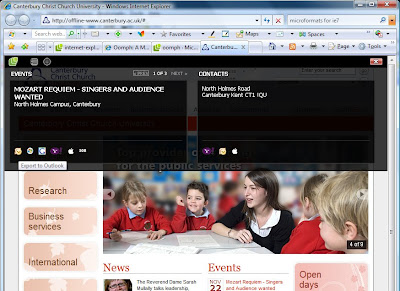
In the above example the "tagged" content is displayed in the list view over the page displaying events and contact details. Both of these can be exported directly into your Outlook, Google, Windows Life, Yahoo and/or Apple Mac calendar.
Below, the "tagged" location content is displayed on a map.
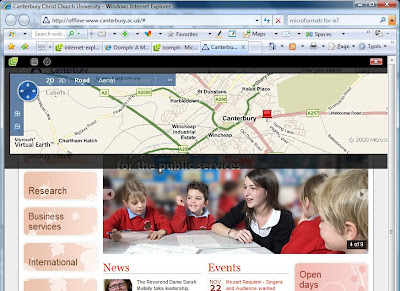
There are other solutions for Firefox and Safari including tools like TailsExport and Operator. These again convert the "tagged" content into structured information with the ability to export to various programmes including Outlook.
If you have any questions regarding Microformats or the WebTeam's implementation of these please leave a comment and we'll respond.
Thursday, November 13, 2008
Is this the future ... hmm ... not quite
A small article in the most recent .NET magazine grabbed my attention and after reading the first paragraph and seeing the images on screen, I immediately came to the conclusion that an amazing technological future is upon us.
"The reason was the Sekai Camera, an iPhone application that takes the view from the phone's camera and augments it with data overlays including user-generated content. Could this be the future of social apps?" (.NET Magazine December 2008, page 52)
So, my first thought was, this application connects to the video of the iPhone, and recognises the shapes of buildings, and along with geolocation GPS gives you the right content. This would be a killer application, especially if it was to connect to existing XML datasources to provide the content that you see on the screen.
However, it is much simpler than that. It only uses the geolocation. Where you are and in which direction you point the iPhone draws the appropriate data from a demo database.
Although, still an amazing piece of social app for your iPhone it is somewhat misleading in lending too much emphasis on the video aspect of the application.
But nevertheless a step in the right direction!
Subscribe to:
Posts (Atom)